How to Choose the Best Safety Boots for Mining
The best safety boot for mining is the one that matches the hazards on your site. Start with a list of the risks your crew faces, then pick the boot features that answer each one.
Know the hazards on site
Every site is different, but these are the risks mining crews meet most often:
- Falling objects, and feet caught under material or equipment
- Sharp rock, nails and metal scraps that can pierce a sole
- Mud, water and oil that make the ground slippery
- Hot surfaces around machinery and processing areas
- Areas with a static electricity risk
Write down which of these apply to your site. That list drives every choice below.
1. Check the toecap is tested to standard
The toecap protects the toes from impact and crushing. On safety footwear that meets ISO 20345, the toecap is tested against a 200 joule impact and 15 kN of compression. In Indonesia, the national standard is SNI 8877:2023, set by BSN and aligned with ISO 20345 and ISO 20344. Ask for the certificate or test report before you buy.
2. Choose a puncture resistant midsole where sharp objects are common
Sites with sharp rock, nails or metal offcuts need a puncture resistant midsole. Some are steel, others are non-metallic and more flexible. Check the spec sheet to see whether it comes as standard or as an option.
3. Look closely at the sole
An SRC rating means the sole has been tested for slip resistance on ceramic tile with a soap solution and on steel with glycerine. Near hot surfaces, choose a heat resistant nitrile rubber outsole. A deeper tread helps in mud and gravel.
4. Pick the right height and style
- 6 inch boots cover the ankle and suit most mining work.
- 9 inch pull-on rigger boots go on fast and cover higher up the leg.
- Zipped boots are quick to get in and out of and still cover the ankle.
5. Anti static where required
If your site's risk assessment calls for protection against static electricity, choose a model with an anti static option.
6. Comfort matters on long shifts
Mining shifts can run 10 to 12 hours. Weight, a lining that handles sweat, a flexible insole and the right size all add up by the end of the day. Uncomfortable boots tend to come off during the shift.
Checklist before you buy
- Certified, with a toecap tested to 200J and 15kN
- Puncture resistant midsole if the site has sharp objects
- SRC slip resistance, plus a heat resistant outsole if needed
- Boot height that suits the job
- Anti static where required
- The right fit when tried on with work socks
KRUSHERS® options for mining
- Grasberg: a 6 inch zipped mining boot.
- Texas: a 9 inch pull-on rigger boot from the Classic range, with a dual density TPU/PU sole, buffalo full grain leather upper and SRC slip resistance. Options include a nitrile rubber outsole rated for heat up to 300°C, a steel midsole and anti static protection.
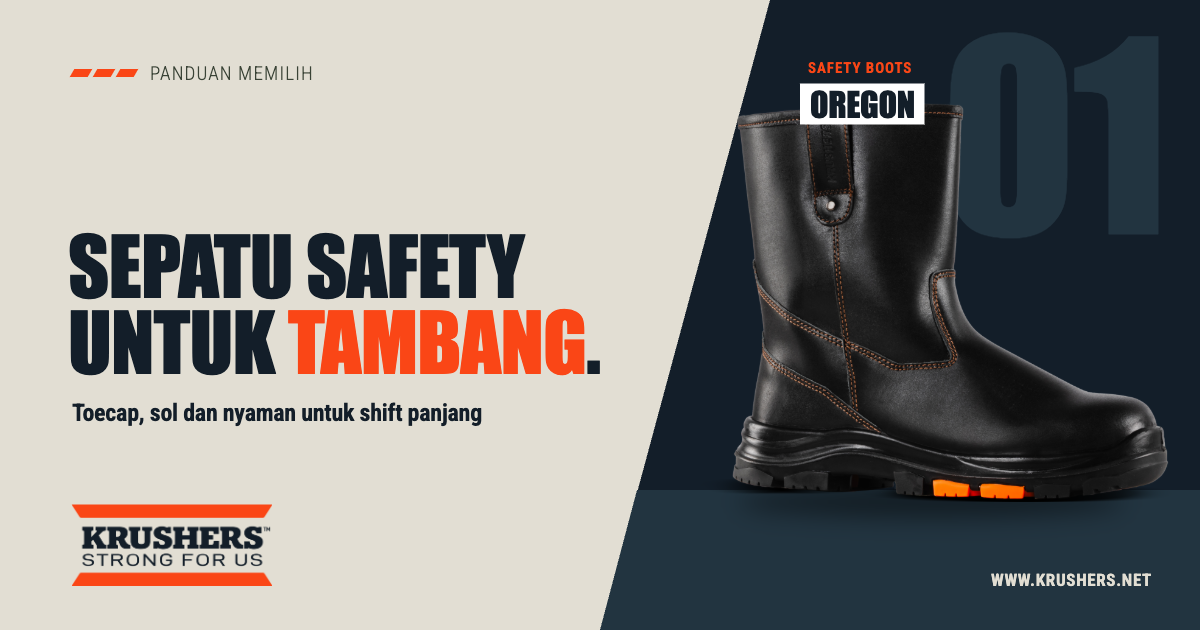
- Oregon: a 9 inch pull-on rigger boot.
Check the full spec of each model on its product page, or ask your nearest KRUSHERS® distributor. KRUSHERS® Arizona is the first safety shoe in Indonesia certified to SNI 8877:2023.
Frequently asked questions
- When should mining boots be replaced? When the sole is worn smooth, stitching has opened, the upper is torn enough to expose the toecap, or after a heavy impact. A toecap that has taken a hard hit can be deformed even if it looks fine from outside.
- Are rigger boots suitable for mining? Yes, especially for work that involves moving in and out of areas and taking boots on and off often. Make sure they fit well so the heel does not slip.
- Do open pit and underground work need different boots? Often, yes. Floor conditions, moisture and hazards differ, so follow the risk assessment for each area.
Need safety boots for your mining crew? Contact KRUSHERS® for a bulk quote.